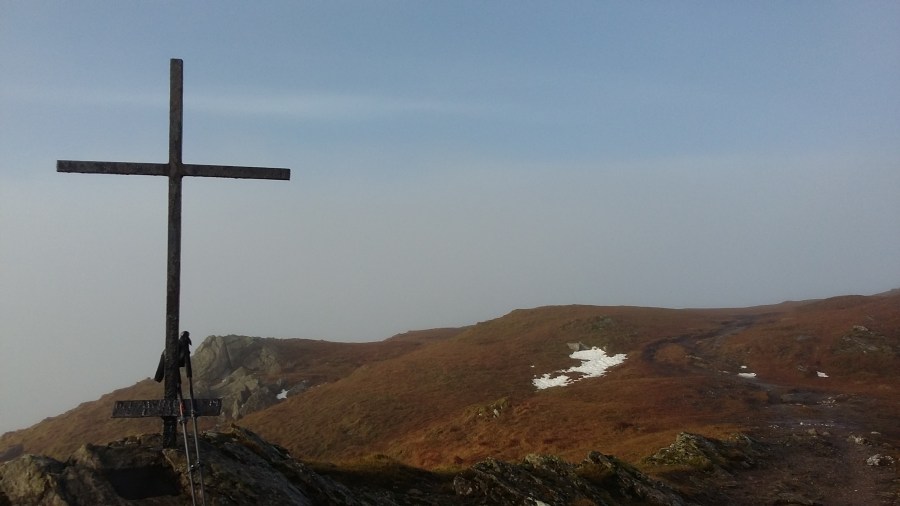
“I’d rather be in the mountains thinking of God, than in church thinking about the mountains” (John Muir)
Regular readers (of my Facebook page) will know that I have been a recent convert to the art of climbing Munros[1]. It’s been great. I am much fitter than I was, and I have lost a lot of weight[2].
As I have been wandering on the hills over these past 18 months, I have been reflecting on the emotional and spiritual benefits of my new pastime (i.e. there’s more to it than the physical benefits). And so I have begun, somewhat inadequately, to ask whether there is such a thing as a ‘spirituality of the mountains’.
The buzz that you get from summiting a big hill, whether in fair weather or foul, is noticeable. I drive home from my days out on an adrenaline high, and annoy my wife immensely with my enthusiasm when I get home from such a day. So I do need to ask whether I am overly-spiritualising what is simply a natural human reaction, the combination of a sense of achievement with a flood of endorphins and adrenaline. Maybe nothing is going on except a combination of well-earned psychological and physiological rewards for what is simply a jolly good day out.
But what if there is more to it than that?
As a starting point, I have been mulling over the Romantic concept of the ‘sublime’[3]. An idea with gothic undertones, the experience of the ‘sublime’ moves the imagination to awe because it is simply beyond words. I have struggled to describe to myself (never mind to anyone else) the emotions that are stirred up by the ‘mountain top experience’ of being on a mountain top. Even in high winds (when I do my best to find a corner to leeward), I cannot help but sit and stare at the view when I reach a summit. I have seen fellow walkers get to the summit, touch the cairn or trig point, and immediately carry on to the next summit or head back downhill. Honestly, I do not understand this behaviour (unless it’s blowing a hooley). To sit and stare, to drink in the view, the scale and the very wilderness, is one of the reasons I do this. And even as I write this, feelings and memories well up that are beyond words and beyond description. The only way into this experience is to do it for yourself.
It’s not a big leap from experiencing the mountains as ‘sublime’ to seeing the mountains as Creation, displaying the handiwork of the Creator. For Christians, this is an easy step and one that see people expressing all the time on Facebook (usually accompanied by a beautiful view rather than a sticky bog, although the principle presumably applies to both).
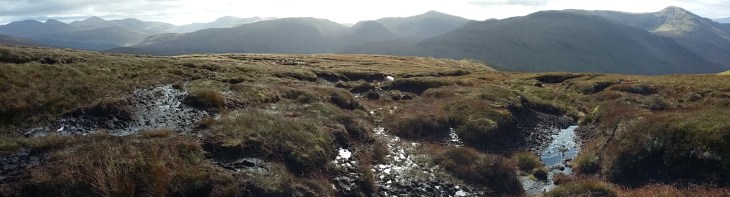
The pilgrim song in Psalm 121, sung by those making their way up to Jerusalem, is an obvious starting point for this move from creation to the Creator; “I lift up my eyes to the mountains – where does my help come from? My help comes from the LORD, the Maker of heaven and earth” (v1-2). Psalm 65 explores the theme of gladness at the bounty of the harvest, provided by the One who made the very mountains themselves (Ps 65, especially v6 and v12). This dual theme (of prosperity and fullness of life, and of the creative power of God which far exceeds the immensity of the mountains) is repeated elsewhere in the Psalms (Ps 72:3,16; 147:8 for the former, Ps 114:3-6; 148:9 for the latter). So this is not a distant Creator; he is greater than the mountains but he is close, and he looks after and provides for his people. Jesus makes the same connection between creation, the Creator and his loving provision, in the Sermon on the Mount, in Matt 6:25-34.
The question then arises as to whether throwing oneself up a mountain might be some kind of spiritual discipline?[4] I have certainly heard God speak, and heard myself speak, during the loneliness and quietness of these walks[5]. There is a certain profundity of aloneness and of space when you get out onto a hill by yourself (especially on the quieter, more remote and less popular ones). With our modern, safe and well-regulated lives, there is something about the mountains that makes you aware of your limits, your fragility, and your vulnerability (it wouldn’t take much to get yourself into a whole heap of trouble while out on a remote hill, especially if you are careless, or even if you’re just plain unlucky). Travelling light, exercising patience, and encountering silence – all of these are good disciplines to bring back to the hurly-burly of our busy ‘normal’ lives.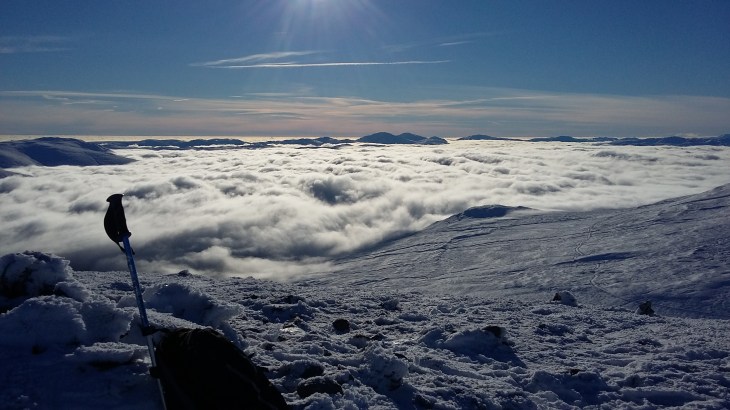
Can we go further than this, and ask whether it is possible to encounter God in nature itself (rather than the natural world being seen as his handiwork, throwing both it and us into finite and limited relief)? Here we enter into a whole world of theological reflection that can barely be touched upon in a single blog post[6]. The Old Testament certainly majors on the difference between God and his creation (this is the polemical theme of the very first chapter, Genesis 1). In the context of the pantheistic and primal religions of Israel’s neighbours, this was a key and vital theological point. But this has been turned into one of the charges against Christianity in the contemporary environmental crisis. By emphasising human uniqueness, as those made in the image of God, the natural world simply becomes a resource to be exploited and used by humanity for its own benefit. A tree has no sacred quality and no intrinsic relationship to its Creator; it is useful only insofar as it is used by humanity to build a house or to heat a meal. A mountain becomes the basis for a mine or a quarry, as a source of metal ore, coal or aggregates for road-building. It becomes valuable only when a human uses it.[7] One response to this has been to change the language of ‘rulership’ or ‘dominion’ in Gen 1:26 to that of ‘stewardship’, which implies a duty of care towards the non-human creation by humanity as regents. But this still retains the emphasis on the distinction between creation and the Creator.
In “God in Creation”[8], Jürgen Moltmann points out that the ability of Jews and Christians to speak of the world as ‘creation’ does not come from a direct encounter with God in creation itself. It comes from a direct encounter with God through his saving acts, and only then does creation becomes the wider context for these saving acts. From their unique experience of the Exodus, of the covenant at Sinai, and the conquest/settlement of Canaan, Israel then interpreted its wider experience of the world. Creation shows that the God of Israel is the Lord of the whole world, which thus enters into the light of the salvation that Israel has experienced and longs for (Isa 42:1-17). In Jesus Christ, this promise and anticipation is brought near and fulfilled, and then spread to the nations through the mission of the Church.
Moltmann also uses the ancient doctrine of the vestigia Dei. Creation, even under its current conditions of sin and corruption, contains ‘traces’ of God, hidden tokens of his presence. The natural world is neither the revelation nor the image of God, but traces of these lie within it, the interpretation of which is found within the final revelation of God in Jesus Christ. “Only the person who knows God, because God reveals himself to him, is capable of recognising and interpreting the traces of God in nature”[9]. Hence it is no surprise that Christians so often see the handiwork of the Creator in his creation.
Moltmann’s famous eschatological focus also comes into play here. Just as Jesus’ parables are eschatological, demonstrating the hidden presence of the future, so also creation is a parable of its own future, the Kingdom of God. At present, it strains with anticipation (Rom 8:19-21). Thus, for Moltmann, our present experience of nature is an anticipation of the future. It represents the promise of future glory, though not the future glory itself. Ultimately, “all created things will participate directly and without any mediation in God’s eternal life. The Creator’s distance from that [which] he has created will be ended through his own indwelling in his creation; though the difference between Creator and Creation will not disappear”[10].
Adrenaline and endorphins; an experience of the sublime; a spiritual discipline; an insight into the Creator’s handiwork; and an anticipation and foretaste of the future glory to be revealed. All that from a mountain. What’s stopping you?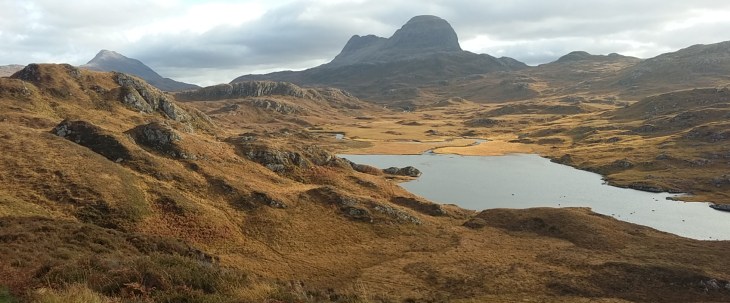
[1] Hills in Scotland above 3000’. I recently summited my 50th Munro (49 of which I have done in the last 18 months). Only 232 more to go!
[2] Over 20kg in the past 18 months 😊
[3] See https://en.wikipedia.org/wiki/Sublime_(philosophy) and http://www.tate.org.uk/art/research-publications/the-sublime/the-romantic-sublime-r1109221
[4] I’m grateful to my friend Neil, who first mentioned this idea to me.
[5] Perhaps the Holy Spirit inhabits the top of mountains in the same way that He seems to inhabit the UK motorway network and the bath/shower. Or is it simply that these are all places where we stop talking long enough to listen and hear Him speak?
[6] Not, you will note, that this is going to stop me trying!
[7] Arnold Toynbee (1974), “The Religious Background to the Present Environmental Crisis” in David and Eileen Spring, Ecology and Religion in History, Harper and Row, p146.
[8] Jürgen Moltmann (1985), God in Creation, SCM Press
[9] Moltmann, God in Creation, p64
[10] Moltmann, God in Creation, p64

 Just About Leading
Superb post, opening up so many ideas. I’m amazed that no one has yet written (at least not that I can find) a biblical theology of mountains.
On spiritual disciplines, I usually associate these with things that, at least on some – often surface – level we don’t want to do, but we do in order to engage the inner being with God rather than just pleasing our soulish and corporeal selves. I can see some of this in getting up early to climb a mountain. There’s perseverence in there too, and the attainment of goals, and the literally walking out of the life-metaphors of ups and downs, valleys and mountain tops, false summits, and so on.
A thought-jog through the BIble and mountains would throw up ideas of meeting God. You’d have to be something of a flat-earther to think in physical terms of mountain tops being closer to heaven, but I know that spiritually they usually are that way. There is Biblical imagery too of mountains crumbling to the sea (Psalm 46) and the rocks splitting when Jesus yielded up his spirit. So mountains are used there as a way of expressing the power of God, as in, He is stronger even than … than … well, than the mountains themselves (Matthew 17:20).
A final and somewhat quirky question, but I’m just wondering, have you ever seen someone climbing a mountain with headphones in, blocking out the sounds and the awesome silences of nature?
LikeLike
“Some people, in order to discover God, read books. But there is a great book: the very appearance of created things. Look above you! Look below you! Read it. God, whom you want to discover, never wrote that book with ink. Instead, He set before your eyes the things that He had made. Can you ask for a louder voice than that?”
― Augustine of Hippo
LikeLike
Of course there is a spirituality of mountains. As a Munroist (one who has compleated (sic) the Munros as well as having climbed many other lesser, in height only, hills, I have had many “God” experiences, from the sense of awe at the skill of the Creator, to “Oh God, please rescue me from the awful trouble I’m in right now in the face of this tremendous act of yours, manifesting itself in blizzard, whiteout, windchill & howling gale…
I have laughed, danced, cried & shaken with fear on these marvellous mountains, experienced deep joy & blinding terror. I have been convinced beyond any church experience that God lives & moves all around us.
I have written verse & prose & blogs on the subject…..
Welcome to the wonderful world of mountains where we do not naturally belong…..and where our frailty & vulnerability leads us to say my God, my God, why have you forsaken me, & in the pub later, to know that he has not….
LikeLiked by 1 person