David Másilka, Ivo Jirásek, Adéla Růžičková, and Michal Petr (2025), “Profiting from individual investment in winter outdoor activities: expanding participants’ life horizons”, in Journal of Adventure Education and Outdoor Learning, Vol 25 No 2, pp439-459 https://doi.org/10.1080/14729679.2023.2256902
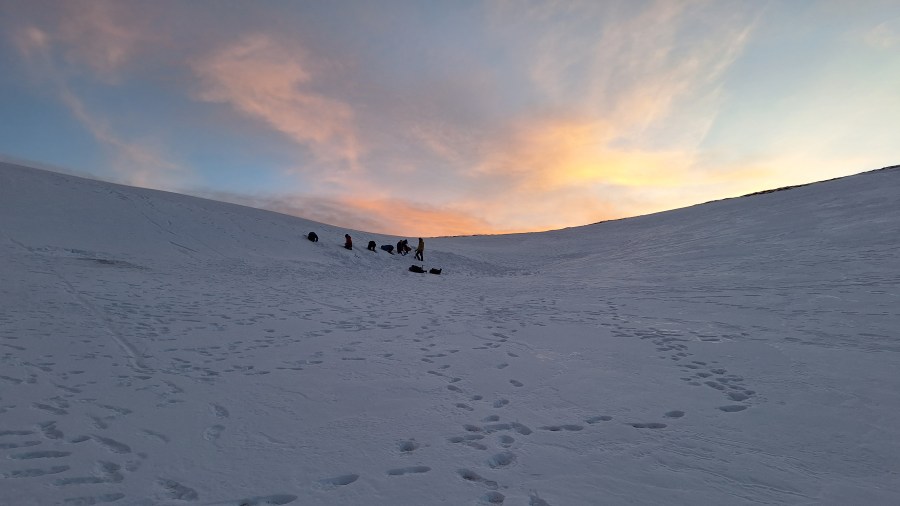
The most positive and inspiring aspects to this research project are its scope and depth of ambition. Using a 5-day winter wild camping expedition in the Poloniny Mountains on the border of Slovakia, Poland, and Ukraine, with snow depths averaging one metre and requiring snow shoes, the programme aims to have a far-reaching impact on participants. As well as considering issues like self-concept, skills development, resilience and well-being, and the enhancement of relational functioning, it has a much wider aim of broadening participants’ worldviews and the “transformation of their life horizon”.
It is this last aspect that the project sought to ‘measure’. Drawing on the concept of transformative learning (that is, a change in perspective on how we see ourselves and our relationships), the programme has an even deeper focus on what it calls the life horizon. This refers to the way by which we experience the present in the context of our past with its memories and our future with its hopes. The paper likens this depth of transformation to being akin to that of a religious conversion, which it describes as a “radical transformation of values, attitudes, and social grounding, i.e. total identity, a turning point in life” (p441). Not only is this a fairly ambitious goal for a 5-day winter expedition, it also sounds quite difficult to measure.
The participants in this student were postgraduate students at the Faculty of Physical Culture at Palacký University Olomouc in Czechia. Expeditions took place in February 2018 and February 2019, with 16 students on each trip, accompanied by 4 instructors from the university staff. The students undertook the expedition as the core component of a module called the Winter Camping Course (WCC).
A qualitative research methodology was used for the study. Within two weeks of the end of the trip, students write a short reflective essay (of 700-1000 words), “the essence of which is to capture and verbalise the main moments of learning, preserving and processing experiences and impressions, and transforming them into future experiences” (p445). The brief temporal distance from the experience allows for new meanings to develop post-event and so deepens the learning experience. Using thematic analysis, the essays were open coded and subjected to constant comparative analysis, with the particular goal of identifying the potential of the WCC for life horizon transformation.
One limitation of the study is the relatively short nature of the reflective essay. A total of 28 out of a possible 32 essays were submitted, and the two-year analysis was done in attempt to achieve some form of data saturation. In addition, the essays’ dual use for personal learning and research project analysis is another limitation, because of the primary need for students to focus on the former when writing it. However, the authors argue that the data returned by the analysis was so rich and consistent that the conclusions drawn can be seen as well-founded. One final limitation is that the students’ prior commitment to the programme of study could have predisposed them to be positive towards the outcomes of the WCC (although from personal experience I would argue that students are all too willing to make it clear when the focus of the programme of study is not meeting their needs and expectations).
The core findings of the study are that students found the WCC to be well worth the investment of time and effort, that an experience of nature and discomfort has a positive transformative effect, the ability to be yourself with others is powerful, and that lessons of self-discovery as well as acquiring specific skills for moving and camping in the mountains in winter were profound; “they pushed the limits of their perceived capabilities and found that they could do more than they thought they could and wanted to benefit from this experience in their future life” (p451).
All of this sounds somewhat familiar to the findings of many other research projects on outdoor adventure experiences. The final words of the previous paragraph – “wanted to benefit from this experience in their future life” – do however take us towards the specific goal of this research project, which was the expansion of the students’ life horizons per se. This agenda was set at the very beginning of the expedition by a visit to the Orthodox church in Osadné, Slovakia, where the local “Pope” (priest?) gave a talk on the history of the place, connecting the forthcoming journey with the powerful stories of the Poloniny Mountains. The students’ mindsets were thereby set in a specific direction just as the expedition began.
What the analysis identified was that while the winter skills acquisition was considered useful by the students, it was the relationships that were established with others during the trip that were thought to be of more long-term benefit. And even more than that, “we consider the most important participant gains to be in the area of self-knowledge and awareness of one’s own boundaries” (p454). Participants discovered the need to intersperse activities with contemplation, and in a world of over-stimulation and information excess, of impulses and distractions, there is a need to find space for relaxation and calm to allow us to truly perform and find creative solutions. This is “not wasted time, but rather a prerequisite for the full realisation of life’s possibilities” (p454). Going yet further, as well as this growth in self-knowledge, participants experienced the world of nature as a place of beauty and wonder and discovered the possibility of transcendence through their experiences of discomfort in nature. Which seems like a decent outcome for a 5-day course.
In the end, a 5-day course can only achieve so much. The WCC did open up questions of self-reflection and the meaning of one’s own life for the students, and so we can conclude that their life horizons were duly expanded. But, as the paper concludes, the transformation of one’s perspectives on life is itself a life-long process. Nonetheless, “the short experience gained through the WCC can open up and change the broad horizon of the whole of life and be seen as a transformative experience that reveals new life horizons” (p455).

 Just About Leading